.png)

.jpeg)
.png)

The tender process is a structured procurement method used by government agencies, councils, universities and private organisations to purchase goods and services. Typically, it involves publishing a request for tender (RFT), receiving submissions, evaluating suppliers, awarding a contract and commencing delivery.
Whether you’re bidding for a government contract, local council project, or private sector opportunity, understanding the tender process is critical to winning more business.
The tender process is a structured procurement method used by organisations to source goods, services, and works from external suppliers. It ensures fairness, transparency, and value for money while allowing buyers to compare multiple suppliers against consistent criteria.
This guide explains each stage of the tender process, common pitfalls to avoid, and how suppliers can improve their chances of success.
What you’ll learn
- How the tender process works from start to finish
- The 8 stages every supplier should understand
- Common mistakes that can derail a submission
- What buyers look for during evaluation
- Tips to improve your chances of winning contracts
What is the tender process?
The tender process typically involves eight stages:
- A buyer publishes a Request for Tender (RFT)
- Suppliers identify suitable opportunities
- Suppliers decide whether to bid
- Tender responses are prepared
- Submissions are lodged before the deadline
- Responses are evaluated
- A preferred supplier is selected
- The contract is awarded and delivery begins
While simple procurements may be completed within a few weeks, complex projects can take several months from release to contract award.
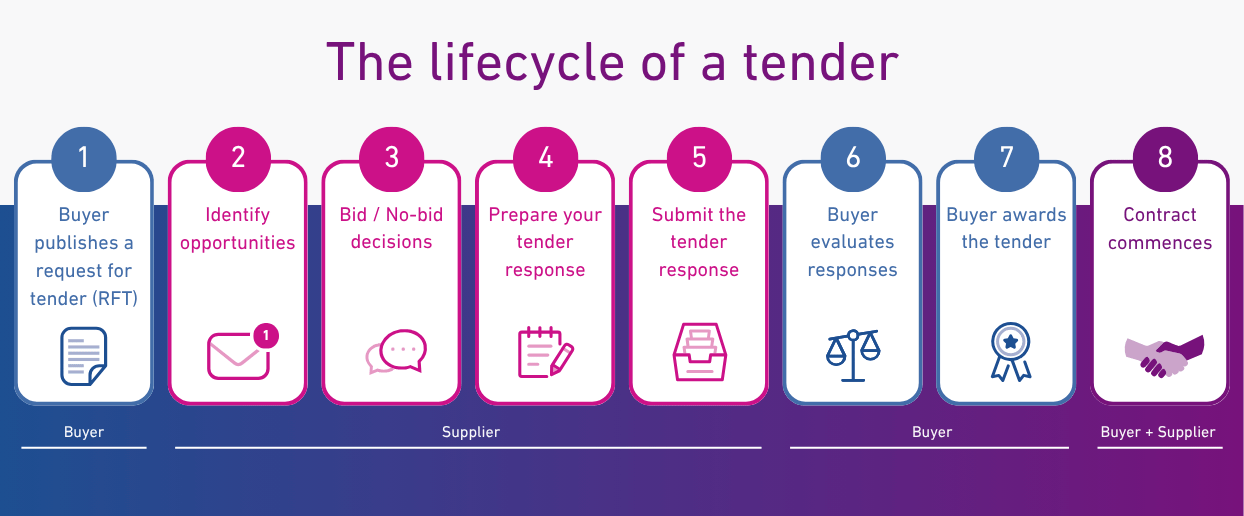
Not familiar with some of the terms we use, like ‘Buyer’ or ‘portal’? Check out our glossary! Or if you just want to get a general idea of what we do, check out this short video, See How it Works.
The 8 Stages of the Tender Process
Stage 1: The Buyer Publishes a Request for Tender (RFT)
- Opportunities from our 600+ Buyer Partners are published through their TenderLink e-procurement portals, or our casual advertising portal, AdCentre. These are stored directly in our tender database.
- Tenders published outside of our portals, such as in newspapers or on a government website, are added to our database by our dedicated research team, who monitor thousands of sources across the entire Australasian market every day.
Stage 2. Identify opportunities
- If you have a TenderLink subscription, you’ll automatically receive an email notification of any new public tenders (both from our Buyer Partners or external sources) which match the category, location, and/or keywords in your search profile, so that you get full coverage of your industry and can start preparing your response immediately.
- If you don’t have a paid subscription, you can search our Buyer Partners, register to each portal for free, and receive notifications whenever they list a new opportunity. With this option, you’ll have to create a new TenderLink account for each portal, and you’ll get separate email notifications from each. To access tenders from other sources, you’ll need to manually search online and in newspapers.
Stage 3: Bid / No-bid decisions
- Download all of the tender documents, read carefully and ask yourself; does the contract fit your business strategy? Can you deliver the work in accordance with the client’s terms and expectations? Make a well-informed decision to bid or not to bid, and make sure you clarify anything you’re unsure of – our portals include an online forum where you can ask Buyers questions publicly or privately.
- Brief all staff involved in preparing the submission so that you can agree on a unified approach, and begin collecting the relevant information/contributions you’ll need from various business areas (finance, sales, account managers, procurement, bid writers, etc).
Stage 4: Prepare a response
- Your response should include things like a cover page, executive summary, qualitative schedules (answering questions), quantitative schedules (proposed pricing), references, and any appendices. Remember to proof-read and ensure your bid is compliant – while this isn’t necessarily what wins tenders, it can certainly cause you to be disqualified based on a technicality or missed requirement.
- We recommend keeping your response client-focused and using persuasive writing to highlight your point of difference. If you’re looking to develop your tender response writing skills and improve your win rate, check out our webinars hosted by BidWrite, for premium and enterprise subscribers.
Stage 5: Submit the tender
- These days, most bids need to be uploaded electronically, as opposed to submitting physical documents to a tender box. Most of our Buyer Partners require submissions through their portals, while other Buyers may require you to submit your response through their website or via email. Either way, it’s a good idea to compress or ‘zip’ your files, as many electronic tender boxes have a size limit for uploaded documents.
- You must submit your tender response on time, or preferably early in case anything goes wrong or files are slow to upload. In most cases, tender submissions received after the nominated closing date/time are treated as non-compliant and will not be considered.
Stage 6: Evaluation
- Buyers evaluate on a number of aspects, such as capability and competence, relevant prior experience, competitive pricing, value for money, risk, and compliance. Our Buyer Partners also have the option of using our Evaluation Toolset, which allows them to create standardised tender response templates, define a scoring system upfront, and assign different weightings to key criteria.
- You may be invited to attend a post-tender interview to give further details and clarification of your ability to carry out the work, or be given the opportunity to negotiate on price or timeframes.
Stage 7: Award
- The Buyer will award the tender to whichever company best meets their evaluation and scoring criteria. Our Buyer Partners will often award tenders directly through their portal, sending an email notification to both successful and unsuccessful applicants, then following up with the contract. Occasionally Buyers may prefer to make contact via phone call, or sometimes meet in person.
- Any public information about the tender outcome (e.g. who won the contract, how much it was for, start and end dates etc.) is also collated in our database. For our Buyer Partners, this happens through their portal, and for external Buyers, our research team monitor tender sources for this information too. Most of our paying subscribers then have access to this tender outcome data, and can either have it emailed to them regularly or can search the database, allowing them to identify more opportunities by way of subcontracting, or monitoring end dates to predict when contracts will come up for renewal.
Stage 8: Contract Commencement
- Congratulations! You’ve secured the much-needed work to keep your business thriving, and are continuing to build a valuable relationship with the buyer – which could lead to further opportunities down the track.
- Although you’ve now got your hands full with current work to do, it’s still an important time to be aware of upcoming opportunities, so you can line up future work for when this contrat comes to an end. Keep looking for the next tender!
Frequently asked questions about the tender process
How long does the tender process typically take?
Simple procurements may take several weeks, while complex or high-value projects can take several months from publication to contract award..
What is an RFT?
An RFT, or Request for Tender, is a formal invitation for suppliers to submit proposals for specific goods, services, or projects.
Can small businesses win tenders?
Yes. Many government and private sector organisations actively encourage participation from small and medium-sized enterprises (SMEs).
What happens after a tender is submitted?
The buyer evaluates submissions, may request clarifications and selects the supplier that best meets the published evaluation criteria.
Why are tender submissions rejected?
Common reasons include non-compliance, incomplete information, missing documentation, poor alignment with requirements, and late submission.
A TenderLink subscription gives you the best chance of being notified about opportunities in your industry without any manual searching, so you can get a head start on lining up future work for weeks or months down the track.
If you want to check out the types of opportunities a subscription can provide, search our database for current contracts or request a free sample of tenders hand-picked to suit your business.









.jpeg)


 English (US) ·